
Meridian Planning
Clarity That Moves You Forward
Clear, Confident Planning for Education and Community Organizations
About
My work in school planning began nearly twenty years ago at Strategic Resources West, where I learned directly from one of the most experienced practitioners in the field. While there, I supported districts ranging from 2,000 to 60,000 students—analyzing demographic and socioeconomic trends, writing planning reports, preparing Colorado BEST grant applications, and guiding leaders through enrollment change, attendance area adjustments, and bond cycle planning.I also helped edit a comprehensive school planning book that is now sold nationally and used in university programs. That experience shaped my commitment to clear, accessible planning tools that help district decision makers understand their options and move forward with confidence.After stepping away to focus on my family, I’ve returned to this work with renewed purpose. I founded Meridian Planning to bring thoughtful, data driven, GIS supported analysis to districts of all sizes. The name reflects the heart of my approach. A meridian is a geographic line that helps us understand where we stand and how we orient ourselves. It also carries a deeper meaning: the point of greatest clarity and culmination. Meridian Planning brings these ideas together, illuminating the issues that matter most, aligning data with community context, and helping leaders make decisions that support students today and into the future.My goal is simple: to provide planning support that is clear, grounded, and genuinely useful to the communities that school districts serve.
Case Study: Growth-Ready School Boundaries
The Situation
A fast-growing suburban district serving 6,130 students faced widening disparities in elementary school utilization. One school was projected to exceed 140% of capacity within three years, and most others were expected to be over capacity within six. To plan effectively for future facilities and staffing, district leadership needed a clear, data-driven understanding of demographic expectations, enrollment pressures, and attendance area implications.
Our Approach
The district used a three‑part assessment to create a clear, unified picture of the situation:1 - Thorough Analysis
Reviewed demographic and enrollment data and examined housing development plans to understand recent enrollment patterns and evaluate potential growth.2 - Geospatial Review
Evaluated current attendance areas to determine where enrollment imbalances were developing or expected, using building capacity data alongside present housing patterns and anticipated residential growth.3 - Enrollment Forecasting
Built enrollment projections to highlight where relief was most needed and to prioritize actionable solutions.This assessment gave district leaders a clearer view of emerging pressures and supported proactive, efficient, and fiscally responsible planning to accomodate the expected enrollment growth.
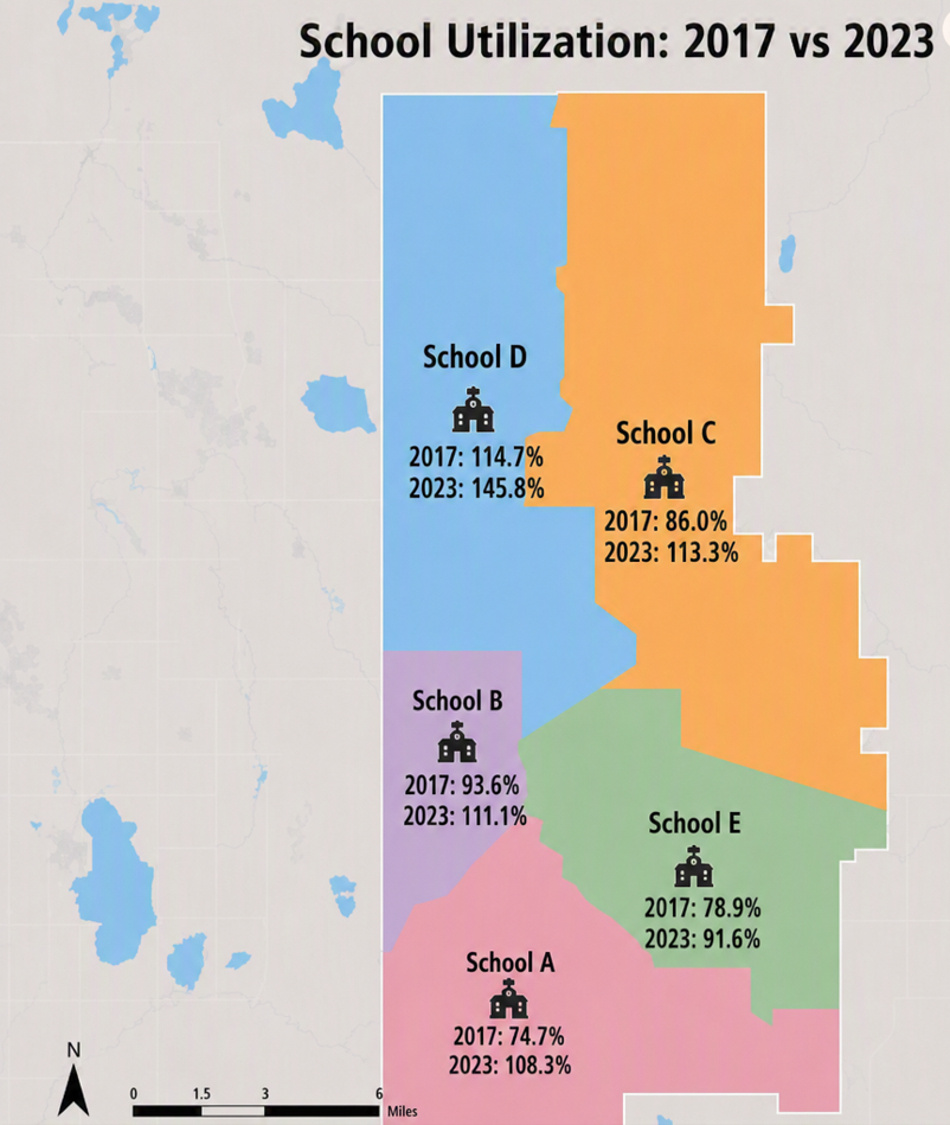
Map of Elementary Utilization
Key Findings
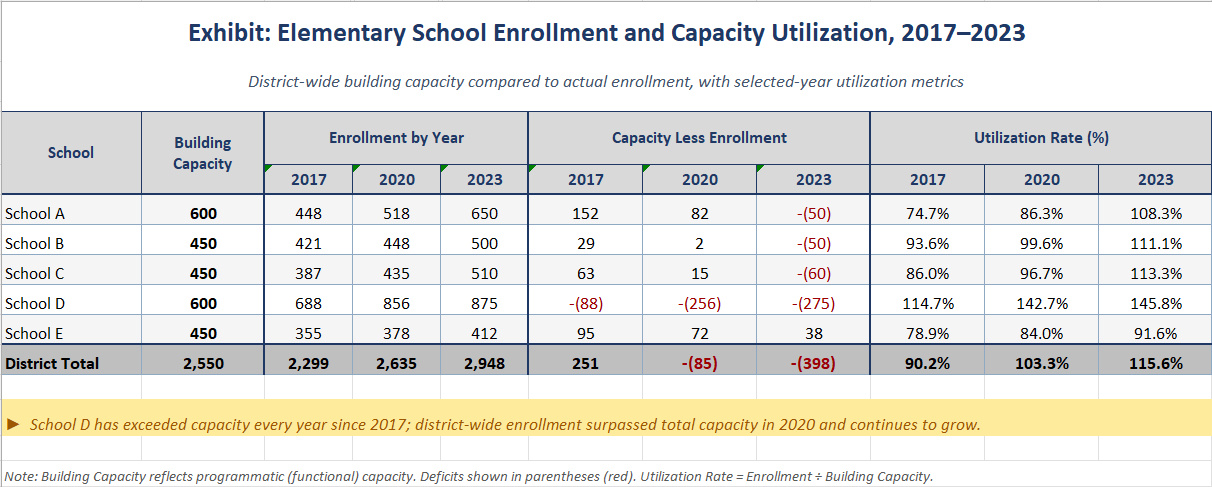
- Four of five elementary schools would exceed designed capacity within six years.- Current attendance areas created a 54% utilization gap between two schools.- Interim measures — including phased attendance area adjustments and overflow busing — could stabilize enrollment.- A bond election would be required to fund construction of a new elementary school.
Enrollment Data
Outcome
The district adjusted attendance areas in phases, advanced its capital strategy with a new elementary school and a middle school expansion, and embedded the enrollment model into yearly budgeting.
Why It Mattered
This phased approach gave the district time to formally update its attendance areas, improving utilization among all schools, reducing transportation costs, and creating more natural neighborhood alignments.
Services
Our services help education and community organizations move forward with clarity — turning complex data into confident planning decisions.
Enrollment Forecasting & Demographic Insight
Accurate enrollment projections and clear demographic analysis to guide long‑term planning.School Attendance Area Planning
GIS‑based attendance area reviews and scenario modeling that support capacity and classroom size issues.Facility Capacity & Utilization Review
Obejective assessments of building capacity, utilization, and future facility needs compared with educational program goals.Strategic Planning Support
Practical, data‑informed guidance for leaders navigating growth and changing demographics.Community Engagement & Communication Support
Clear summaries and visuals that help leaders communicate planning alternatives and decisions effectively.GIS Mapping & Spatial Analysis
High‑quality maps and spatial analyses that illuminate patterns and support confident decisions.
Contact Meridian Planning
Have a project in mind? Let's discuss how demographic analysis, enrollment forecasting, and strategic planning can support your organization's goals.
Or contact us directlyDarci Drost
Meridian Planning, LLC📧 [email protected]📞 303-688-7963📍 Erie, Colorado
Darci DrostMeridian Planning, LLC📧 [email protected]📞 303-688-7963📍 Erie, Colorado